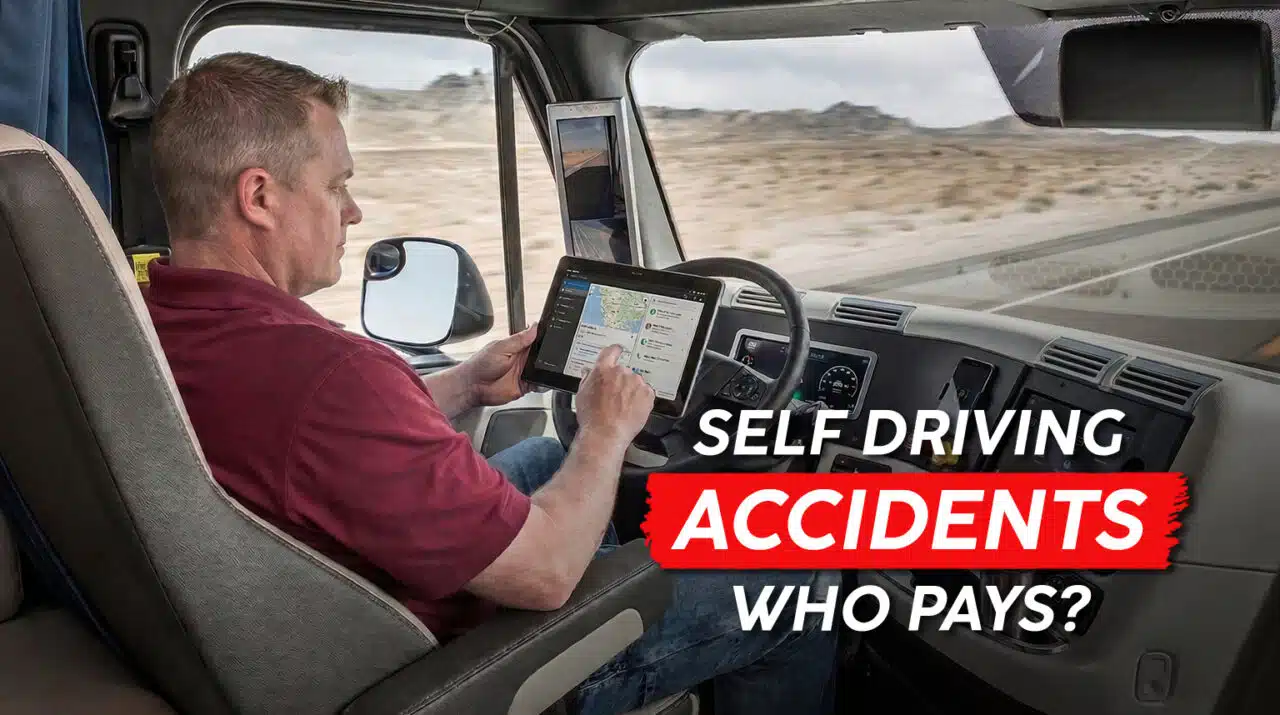
Self Driving Truck Accidents: Why Legal Responsibility Is Becoming More Complex
For decades, truck accident investigations followed a relatively predictable pattern. A crash would occur, evidence would be reviewed, and responsibility would usually fall on the driver or the company operating the vehicle.
But that clarity is beginning to fade.
As automation enters the trucking industry, self driving truck accidents are introducing a new kind of uncertainty, one where responsibility is no longer limited to a single person or entity. Instead, it is becoming a layered, multi-factor issue that involves technology, human behavior, and corporate accountability all at once.
This shift is not just technical, it is fundamentally changing how liability is understood across the entire industry.
Why Traditional Liability Models No Longer Work
In conventional trucking accidents, liability is typically tied to driver actions such as distraction, fatigue, or poor decision-making. In many cases, carriers may also be held responsible through operational oversight, training gaps, or maintenance issues. This model has been relatively stable for years, with clear lines of responsibility that investigators and courts could follow.
However, self driving truck accidents challenge this model entirely. As advanced driver assistance systems (ADAS) become more common and autonomous capabilities continue to develop, control inside the cab is no longer exclusively human. The decision-making process is now shared between the driver and the system, which creates a new layer of complexity when something goes wrong.
When a system contributes to actions such as braking, steering, or hazard detection, determining fault becomes significantly more complicated. In many self driving truck accidents, the issue is not simply what the driver did, but how the technology performed, how it was used, and whether its limitations were fully understood. This overlap between human input and system response makes it more difficult to apply traditional liability frameworks.
This creates a fundamental legal question that continues to shape the discussion around self driving truck accidents: Is the driver still fully responsible if the system played a critical role in the outcome?
As automation continues to evolve, answering this question will become increasingly important for both drivers and the industry as a whole.
A New Era of Multi-Party Responsibility
One of the most important changes introduced by self driving truck accidents is the expansion of who may be held accountable. What was once a relatively direct process is now evolving into a more layered and complex system of responsibility.
Instead of one or two parties, future accident cases may involve:
- The driver (if present)
- The motor carrier
- The truck manufacturer (OEM)
- Software developers
- Technology providers
In many self driving truck accidents, responsibility is no longer tied to a single action but rather to how multiple systems and decisions interact in real time. This transforms accident investigations into complex legal cases where responsibility must be carefully divided across multiple stakeholders, each playing a different role in how the vehicle operates.
As a result, legal disputes are expected to become more detailed, more technical, and more difficult to resolve. Determining fault may require deeper analysis, expert input, and a clearer understanding of how both human and technological factors contributed to the outcome.
When Technology Becomes Part of the Problem
As systems become more advanced, the line between human error and technological failure begins to blur. This is one of the central challenges in self driving truck accidents.
If a system is designed to assist — but not fully replace — the driver, then questions arise:
- Did the driver misuse the system?
- Did the system fail to perform as expected?
- Was the system misunderstood due to unclear design or communication?
These questions highlight how automation can introduce new types of risk rather than simply eliminating existing ones.
Lessons From Early Autonomous Cases
Even though fully autonomous trucks are not yet widespread, early cases involving automated systems in passenger vehicles provide important insight. In one significant case, responsibility was shared between the driver and the manufacturer due to a mismatch between how the system was expected to perform and how it actually functioned.
This suggests that in self driving truck accidents, liability may often be divided rather than assigned to a single party And that has major implications for the trucking industry. Industry coverage and legal insights on autonomous vehicle cases continue to evolve, with detailed analysis available on platforms like Commercial Carrier Journal.

The Challenge of Constant Software Updates
Unlike traditional vehicles, autonomous systems continue to evolve even after purchase. Software updates can change how a truck behaves, responds, and operates over time.
This creates new challenges in self driving truck accidents, such as:
- Determining whether systems were up to date
- Identifying responsibility for missed updates
- Understanding how system changes impact performance
In a world where the “product” is constantly evolving, defining responsibility becomes far more complex.
Regulatory Systems Are Falling Behind
One of the biggest challenges facing the industry is that regulations have not yet caught up with technology. Current rules are built around the assumption that a human driver is always in control. But with self driving truck accidents, that assumption no longer holds true.
Key issues include:
- Lack of unified federal regulations
- Differences between state laws
- Limited guidance on autonomous liability
- Unclear operational standards
This regulatory gap adds another layer of uncertainty to an already complex situation.
A Patchwork of Laws Across States
At present, different states have different approaches to autonomous trucking. Some allow testing and deployment, while others impose stricter restrictions. This creates inconsistency in how self driving truck accidents are handled across the country. For companies operating across multiple states, this can make compliance more difficult and increase legal risk. Learn how technology is shaping trucking: Technology in Trucking: From GPS to Electric Trucks.
What This Means for the Trucking Industry
The rise of self driving truck accidents is not just a legal issue. it is a structural shift in how the industry operates. For fleets, it means:
- Increased focus on risk management
- More complex insurance structures
- Greater reliance on technology evaluation
For drivers, it means:
- Adapting to new systems
- Understanding the limits of automation
- Staying informed about evolving responsibilities
Why Complexity Will Continue to Grow
As technology advances, the complexity surrounding self driving truck accidents is expected to increase rather than decrease.
More automation means:
- More data
- More variables
- More parties involved
While technology may improve safety, it also introduces new challenges in determining accountability.
The Reality: We Are Still Early
Despite rapid progress, the industry is still in the early stages of understanding how to handle self driving truck accidents. While technology continues to advance at a fast pace, the legal and regulatory systems that define responsibility are still catching up. At this moment, there is no clear or universally accepted standard that fully addresses how liability should be assigned when automation plays a major role in a crash.
Much of what we currently understand is based on limited real-world cases and early interpretations of existing laws. However, those laws were originally designed for a completely different environment, one where a human driver was always in control. As a result, applying traditional legal principles to modern automated systems often leads to uncertainty and conflicting interpretations.
Several key factors contribute to this ongoing uncertainty:
- Limited number of real-world self driving truck accidents to establish legal precedent
- Lack of consistent federal regulations specifically addressing autonomous trucking
- Differences in how individual states approach automation and liability
- Rapid technological development that outpaces legislative updates
- Unclear boundaries between human responsibility and system performance
Because of these challenges, future court cases will play a critical role in shaping how responsibility is defined. Each new case involving self driving truck accidents has the potential to set a precedent that influences how similar incidents are handled moving forward. Judges, legal experts, and regulators will gradually build a framework based on real outcomes rather than theoretical assumptions.
At the same time, regulatory bodies are under increasing pressure to develop clearer guidelines. These may include updated safety standards, new definitions of driver responsibility, and more detailed requirements for technology providers. However, creating these frameworks takes time, especially in an industry as complex and high-stakes as trucking.
Until these elements begin to align, uncertainty will remain a defining factor. For fleets, this means operating in an environment where risk is harder to predict. For drivers, it means adapting to systems that are still evolving, both technically and legally.
In many ways, the industry is in a transitional phase, one where innovation is moving faster than the rules that govern it. And until those rules are clearly established, self driving truck accidents will continue to raise more questions than answers.
Final Thoughts
The trucking industry is entering a new era, one where technology is changing not only how trucks operate, but also how responsibility is defined. Self driving truck accidents represent one of the biggest legal challenges of this transition. As automation continues to evolve, the question is no longer just how trucks move — but who is accountable when things go wrong. For now, the answers are still being written.